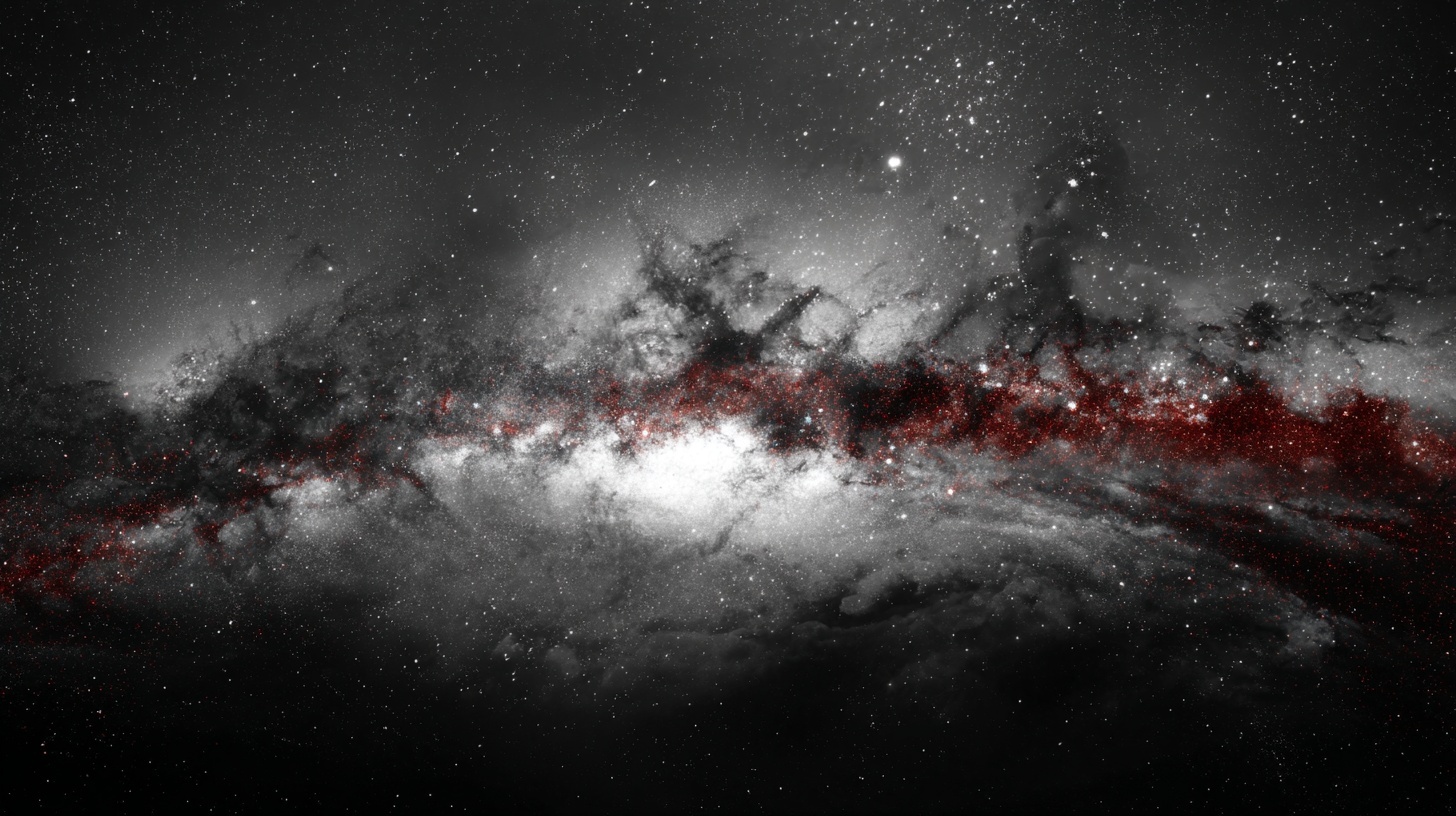
We began our search for companionship by gazing into the deep.
We defined a communicative civilization as one advanced enough to permit detection across interstellar distances. In the early days, we believed water was the source of life. We were wrong.
We sought a deliberate interstellar signal, like a phone call, tuned to a universally radio channel. Which frequency would you choose if you had to find me? My birthday? That could work, but what if you had to find someone you had nothing in common with. What is the lowest common denominator of life?
Water. And so we chose 21cm. We sent out a radio wave with a 21cm wavelength. The wavelength emitted by neutral hydrogen atoms.
And yet, the skies remained silent.
This silence prompted a shift in strategy.
Instead of waiting for an intentional message, we decided to look for the daily signs of life. The leakage signals of a functioning civilization. Like finding a distant city by its lights. To look for habitable planetary systems, we decided to map our entire galactic domain in three dimensions. Then search of quiet nooks where sentient species might thrive peacefully.
To achieve this galactic census, we deployed 2 telescopes. VISTA, specifically to pierce the gas and fog obscuring the central galactic regions, and GAIA, to chart the precise positions and motions of over a billion stars. We hoped to find systems characterized by quiet stability.
But when Gaia delivered its map the data screamed of violence.
The structure of our Milky Way is built upon a process of galactic cannibalism.
Gaia's data uncovered a staggering number of stars. On the order of a million. That were.. foreign. Astronomers performed galactic "blood spatter analysis" by studying two key properties.
First, motion: many of these stars are on strange, highly elongated orbits, frequently moving in retrograde. They are orbiting the galactic center in the opposite direction to the vast majority of our disk. Swimming upstream.
Second, chemistry: these stars have a different chemical fingerprint, a different metallicity, that they inherited from their parent galaxies.
Our galaxy has strange dietary habits.
This cannibalism is not just ancient history; it is happening right now. The Sagittarius Dwarf is currently being consumed by our gravity, its material stripped away into massive, ribbon-like tidal streams that wrap around the Milky Way.
But I ask now a question that struck me as I wrote the last paragraph to you.
If millions of our stars are foreign.. then what of our sun?
The birth of our sun is timed to 4.7 billion years ago. The last Sagittarius Dwarf passage was around 5 billion years ago. Each passage of the Dwarf's orbit through our galaxy's arms pulls apart a handful of stars. It has passed the arms three times in total. The sun appear sometime after the last pass.
Are we even of this place?
Even our closest dearest Andromeda holds skeletons in her closet. Andromeda, the largest galaxy in our local group, grew by eating her young. The curious, compact galaxy we call M32, which appears surprisingly metal-rich and contains young stars, is actually the dense core remnant of a much larger predecessor that Andromeda devoured. M32p, what we call M32s predecessor, must have been the third-largest galaxy in the family at the time.
You, dear earth, exist because of this persistent chaos. You thrive in the immediate aftermath of a gravitational compression that should have signaled only destruction. Yet, the cycle continues: the clock is ticking for the inevitable collision where Andromeda will consume us, too. We sought peace in the silent radio static, but the true story of the cosmos is written in a billion stars. And it is a history of violence.